|
Introduction to the Book of Daniel
by Cooper P Abrams III
|
|
Historical Background
Only the two tribes of Judah and Benjamin remained in Canaan before the Babylonian captivity. The ten northern tribes called Israel had been taken into captivity approximately 722 B.C. This left only the two southern tribes called Judah in the land of Israel.
Judah also was taken into captivity beginning first with an invasion by the Chaldean king, King Nebuchadnezzar. The word "Chaldeans" refers to the Babylonians. Chaldea was originally a small providence in the southern territory of Babylonia at the head of the Persian Gulf. Later when King Nebuchadnezzar II (605-562) established the Neo-Babylonian Empire ("neo" means "new") the name came to be applied to most all of Babylonia.
Judah was not completely destroyed, but was looted extensively. This invasion is referred to as the first deportation. King Nebuchadnezzar conquered Judah, took all the vessels from the Temple and deported the healthiest of the Hebrews back to Babylonia to be slaves. Judah was made a vassal state and was allowed to keep its king. Daniel was among those taken into captivity. Eight years later there was a second deportation in 598 B.C., when Ezekiel was prophesying, followed almost eleven years later in 588 B.C. when Judah was completely destroyed and cease to exist.
The reason God allowed this to happen is found in the following passages of Scripture:
"The word that came to Jeremiah concerning all the people of Judah in the fourth year of Jehoiakim the son of Josiah king of Judah, that was the first year of Nebuchadnezzar king of Babylon; The which Jeremiah the prophet spake unto all the people of Judah, and to all the inhabitants of Jerusalem, saying, From the thirteenth year of Josiah the son of Amon king of Judah, even unto this day, that is the three and twentieth year, the word of the Lord hath come unto me, and I have spoken unto you, rising early and speaking; but ye have not hearkened. And the Lord hath sent unto you all his servants the prophets, rising early and sending them; but ye have not hearkened, nor inclined your ear to hear. They said, Turn ye again now every one from his evil way, and from the evil of your doings, and dwell in the land that the Lord hath given unto you and to your fathers for ever and ever: And go not after other gods to serve them, and to worship them, and provoke me not to anger with the works of your hands; and I will do you no hurt. Yet ye have not hearkened unto me, saith the Lord; that ye might provoke me to anger with the works of your hands to your own hurt. Therefore thus saith the Lord of hosts; Because ye have not heard my words, Behold, I will send and take all the families of the north, saith the Lord, and Nebuchadnezzar the king of Babylon, my servant, and will bring them against this land, and against the inhabitants thereof, and against all these nations round about, and will utterly destroy them, and make them an astonishment, and an hissing, and perpetual desolations. Moreover I will take from them the voice of mirth, and the voice of gladness, the voice of the bridegroom, and the voice of the bride, the sound of the millstones, and the light of the candle. And this whole land shall be a desolation, and an astonishment; and these nations shall serve the king of Babylon seventy years." (Jeremiah 25:1-11)
"Moreover all the chief of the priests, and the people, transgressed very much after all the abominations of the heathen; and polluted the house of the Lord which he had hallowed in Jerusalem. And the Lord God of their fathers sent to them by his messengers, rising up betimes, and sending; because he had compassion on his people, and on his dwelling place: But they mocked the messengers of God, and despised his words, and misused his prophets, until the wrath of the Lord arose against his people, till {there was} no remedy. Therefore he brought upon them the king of the Chaldees, who slew their young men with the sword in the house of their sanctuary, and had no compassion upon young man or maiden, old man, or him that stooped for age: he gave {them} all into his hand. And all the vessels of the house of God, great and small, and the treasures of the house of the Lord, and the treasures of the king, and of his princes; all {these} he brought to Babylon. And they burnt the house of God, and brake down the wall of Jerusalem, and burnt all the palaces thereof with fire, and destroyed all the goodly vessels thereof. And them that had escaped from the sword carried he away to Babylon; where they were servants to him and his sons until the reign of the
kingdom of Persia: To fulfill the word of the Lord by the mouth of Jeremiah, until the land had enjoyed her Sabbaths: {for} as long as she lay desolate she kept Sabbath, to fulfill threescore and ten years." (2 Chronicles 36:14-21)
God's stated reasons for allowing the destruction of Judah and their deportation were (1) their continued idolatry, (2) they mocked and abused God's messengers, (3) they failed to let the land lay fallow every seventh sabbatical year.
Israel's Failures: Idolatry
Idolatry is not only worshiping idols and false gods, but any created thing that is put before God. God's First Commandment is ". . . to have no other Gods before Me."(Exodus 20:3) Israel came into being at the divine decree of God. He made them a special people, the people to whom He would give the special privilege of revealing Himself to the world. No one could know of God and receive eternal life apart from the agency of the Nation of Israel. He further gave the special promises of land and prosperity and most of all He promised them the Messiah the Savior of the world. This was the reason God created Israel and the Jews. They had more knowledge of God than any people on the earth, yet with the knowledge of God they refused to obey God's instruction and receive salvation and eternal life. They rebelled at almost every step of their history.
Rather they chose to worship inanimate objects such as stones, trees, rivers and a host of other things in nature. They worshipped the heavenly bodies as the sun, moon and stars. To try and understand why is to look into the very depravity of man. Man is at heart carnal and a sinner. Paul in Romans 1 states it clearly.
"Because that, when they knew God, they glorified him not as God, neither were thankful; but became vain in their imaginations, and their foolish heart was darkened. Professing themselves to be wise, they became fools, And changed the glory of the uncorruptible God into an image made like to corruptible man, and to birds, and fourfooted beasts, and creeping things." (Romans 1:21-23) Israel knew God, but as Jesus said in John 3:19-20 "And this is the condemnation, that light is come into the world, and men loved darkness rather than light, because their deeds were evil. For every one that doeth evil hateth the light, neither cometh to the light, lest his deeds should be reproved." (John 3:19-20)
God said to the Jews, "I am the LORD thy God, which brought thee out of the land of Egypt: open thy mouth wide, and I will fill it. But my people would not hearken to my voice; and Israel would none of me. So I gave them up unto their own hearts' lust: and they walked in their own counsels." (Psalm 81:10-12)
However, God's love is shown in that even when man willingly rejected Him, He would not be deterred from His plan to save man. "But God commendeth his love toward us, in that, while we were yet sinners, Christ died for us." (Romans 5:8)
Israel's Failures:
They Despised the Word of God Mocking and Misusing God's Messengers.
It should be understood that not all of the Hebrews rejected God. Through Israel's history there were those few who believed God and longed for the day when their nation and its leaders would also. (See 1 Kings 19:18 as an example) They worshipped God and they lived their lives trusting God in faith.
These believers were always the minority and were always oppressed and persecuted by those who practiced false religion. These true saints and prophets believed and taught God's truth which offended the hypocrites and leaders of false religion within their nation. These wicked men hated the very word of God because it exposed their false teachings and their sins. Their shameful treatment of God's messengers the prophets is clear evidence of their despising the Word of God. The messenger was the one who delivered the word of God, but the message was from God! Yet, with no apparent fear of God, they imprisoned and murdered many of the prophets God sent to them.
Note what God says of them in the Bible's Hall of Faith, "And others had trial of cruel mockings and scourgings, yea, moreover of bonds and imprisonment: They were stoned, they were sawn asunder, were tempted, were slain with the sword: they wandered about in sheepskins and goatskins; being destitute, afflicted, tormented; (Of whom the world was not worthy:) they wandered in deserts, and in mountains, and in dens and caves of the earth. And these all, having obtained a good report through faith, received not the promise: God having provided some better thing for us, that they without us should not be made perfect." (Hebrews 11:36-40)
It is clear that the unrighteous hated the men who delivered God's Word to them. Many would even conclude that it was the messenger's fault. But think for a minute. Who called and sent them the messenger? Who was it who chose "that" particular man? The answer is clearly revealed in God's Word. God did. Jesus said in John 10:4-5, that His sheep hear His voice! Those that are truly sheep know when God's speaks and they know who speaks for God. There is no rebellion against the message of God from His children. But that is not so with the children of this world. They hate the instruction from God and they will rebel against it and the messenger sent of God. Jesus said the time would come when in the name of religion they would kill the saints of God and think they have done God a service. (John 16:2)
They Refused to Observe the Sabbatical Years
In Leviticus 25:1-7, God directed the Children of Israel to allow the land to rest each seventh year. After the forty ninth year they were to declare a special "jubilee" in which all land returned to its original owner and slaves were returned to their families. In Lev. 25:21-22, God promised to bless them abundantly in the sixth year with enough harvest to provide for them in the seventh year when no crops were to be planted or harvested. This was God's way of testing Israel and teaching them to trust in Him and live by faith. (See Hebrews 11:6)
Israel never kept even one sabbatical year! For four hundred and ninety years all went well and not obeying God seemed to be of little consequence. In Leviticus 25-1-27 God instructed Israel to allow the land to rest every seventh year. God promised that in the sixth year He would abundantly bless them and the land would yield enough food to last them for two years. Thus, to keep the sabbatical year was an act of faith in trusting in God's provision recognizing that they were God's people. This would be a testimony to all Israel, their children, and to the nations around them of God. Yet, the Bible does not record that Israel ever kept even on sabbatical year. However, God's day of accounting was coming and as 2 Chronicles 36:21 states the land rested for seventy years. Because of their deportation they would not be in the land to disturb it. This period is figured from the time of the first deportation in 605 BC until 536 BC when the foundation of the temple was rebuild. (See Dan. 9:2 and Ezra 1:1)
If Israel had repented God would have forgiven them and they would have been spared this judgment. They refused. God is loving and merciful and His long suffering can be seen in that He waited for them to repent for four hundred and ninety years!
God wanted Israel to live by faith and live according to His promises, yet they would not. They refused to trust God to meet their needs. Their trust was in human ability and them missed the blessing of God and reaped the destructive result of their sin. In human terms, it was unthinkable to "waste" a year of crops. Humanly it would seem they would be poorer for trusting God. It was a simple test of their faith. In the six years before the sabbatical year they did not live by faith and their ignoring God's instruction in the seventh was proof they were not living by faith at any time. Further, the showed they had no fear of God, either reverential or being afraid of his wrath and power. "God shall hear, and afflict them, even he that abideth of old. Selah. Because they have no changes, therefore they fear not God." (Psalm 55:19)
Background on the Book
The modern Bible places the Book of Daniel as the first of the Minor Prophets, as well as did the LXX (The Septuagint [70], the Greek translation of the Hebrew Old Testament) and the Vulgate (Latin Bible). However, in the Hebrew Bible the Book of Daniel is placed among the Poetic Books of Psalms, Proverbs, Job, Song of Solomon, Ruth, Lamentations, Ecclesiastes, Ester, Daniel, Ezra, Nehemiah, 1-2 Chronicles.
Daniel was not a prophet in the normal sense because God did not deliver a message through him directly and publicly to the people. Yet,Jesus called Daniel a prophet in Matthew 24:15. Through him God revealed some of the most revealing of all the prophecies of God. The Book is referred to as being the "Book of Revelations" of the Old Testament because both books are apocalyptic. "Apocalyptic" means an unveiling, disclosing or revelation.
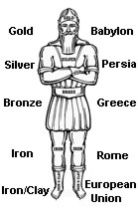
The Book is believed to have been written in 537 BC after the Captivity was ended. The liberal unbelieving scholars (so called by themselves) of the 18th and 19th Century rejected Daniel as the writer of the Book. Their chief premise was that the prophecies in Daniel of the fall of the Babylonian Empire followed by the Persian, Greek and Roman Empires was proof that the Book was written during the Roman period because no could have known of the session of these empires in their correct order. They denied that God could reveal coming history to a man many years in advance. They purported other supposed discrepancies in the Book, however their arguments have been proven invalid by many modern archaeological discoveries. Their main fault is they are unbelievers who deny God to their shame and destruction.
It is clearly established Daniel could and did write the Book. In Daniel 12:4, he claims to have written the Book and this is verified in the New Testament by Christ's reference to him. (Matt. 24:15, Mr. 13:14) It is hard for those who deny God to accept a godly man such as Daniel lived and was greatly used of God. To deny the vality of the inspiration of the Book of Daniel is to deny God's word and man's responsiblity to his God and Creator.
About the Prophet Daniel
Daniel's name means, "God is my judge". In Ezekiel 14:14, 20, the righteousness of Daniel is attested to as well as to his wisdom in Ezekiel 28:3. He is a testimony of God's blessings and use of a man who will believe and yeild himself to be used of God.
God testifies through Ezekiel, "Though these three men, Noah, Daniel, and Job, were in it, they should deliver but their own souls by their righteousness, saith the Lord GOD. . . . Though Noah, Daniel, and Job, were in it, as I live, saith the Lord GOD, they shall deliver neither son nor daughter; they shall but deliver their own souls by their righteousness." (Ezekiel 14:14,20)
Daniel was born to the royal family and of noble birth (Dan. 1:3,6). His physical appearance is said in Daniel 1:4, as being without blemish and well favored. The Book of Daniel covers his life from a teenager to his death as a captive in Babylon. It shows what God can do with a young person that will hold him in good stead throughout his life. He lived to the end of the Captivity and was possibly eighty five when he died, if he was taken into captivity at age sixteen.
USE ARROWS TO GO TO THE NEXT LESSON


|